Tools for Genetic and Genomic Manipulation
The UMGC Innovation Lab develops tools for large-scale gene editing and for facilitating NGS-based analysis.
Automated microinjection
Microinjection is an important technique used by researchers to generate transgenic and mutant organisms. In collaboration with scientists from the Biosensing and Biorobotics Lab, we have developed a computer-vision guided automated system for microinjection of embryos and tissues. We are using this system to explore a number of potential applications, including high-throughput mutational scanning experiments in Drosophila, novel approaches to cryopreservation, and injection of DNA barcodes into cells in tissue slices to label specific cell populations upstream of single cell transcriptomics.
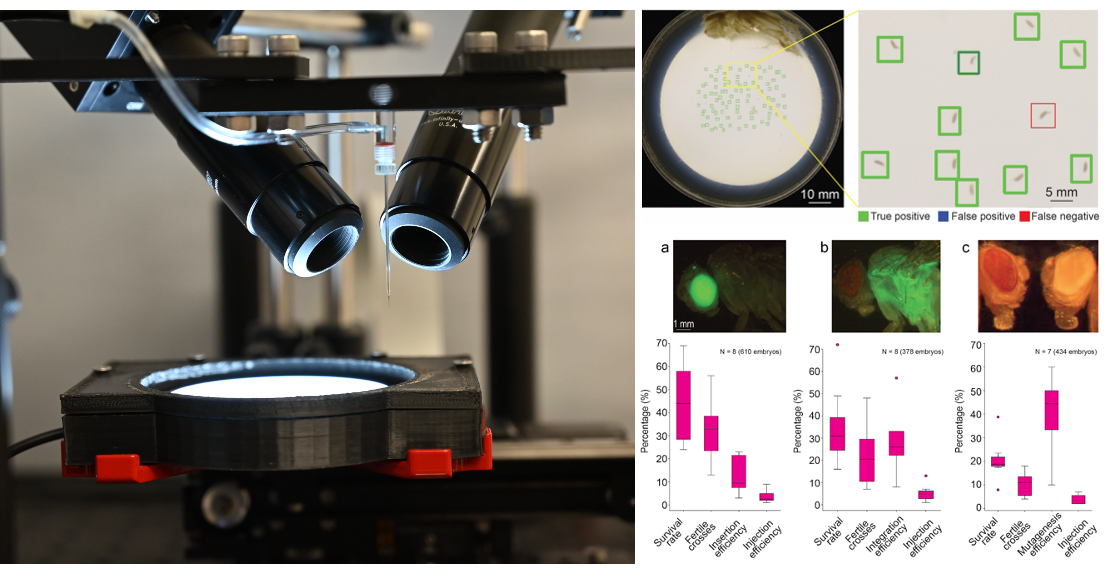
The automated microinjection robot (left) uses computer vision to identify and target embryos for microinjection (top right), enabling high-throughput generation of transgenic and mutant lines (bottom right).
Drosophila Genetic Tools
We have developed a number of genetic tools for Drosophila, include a convertible enhancer trap system (InSITE), a collection of genetically barcoded fly lines (TaG-EM), as well as tools for conditional gene activation and inactivation and methods for large-scale transposon mapping.
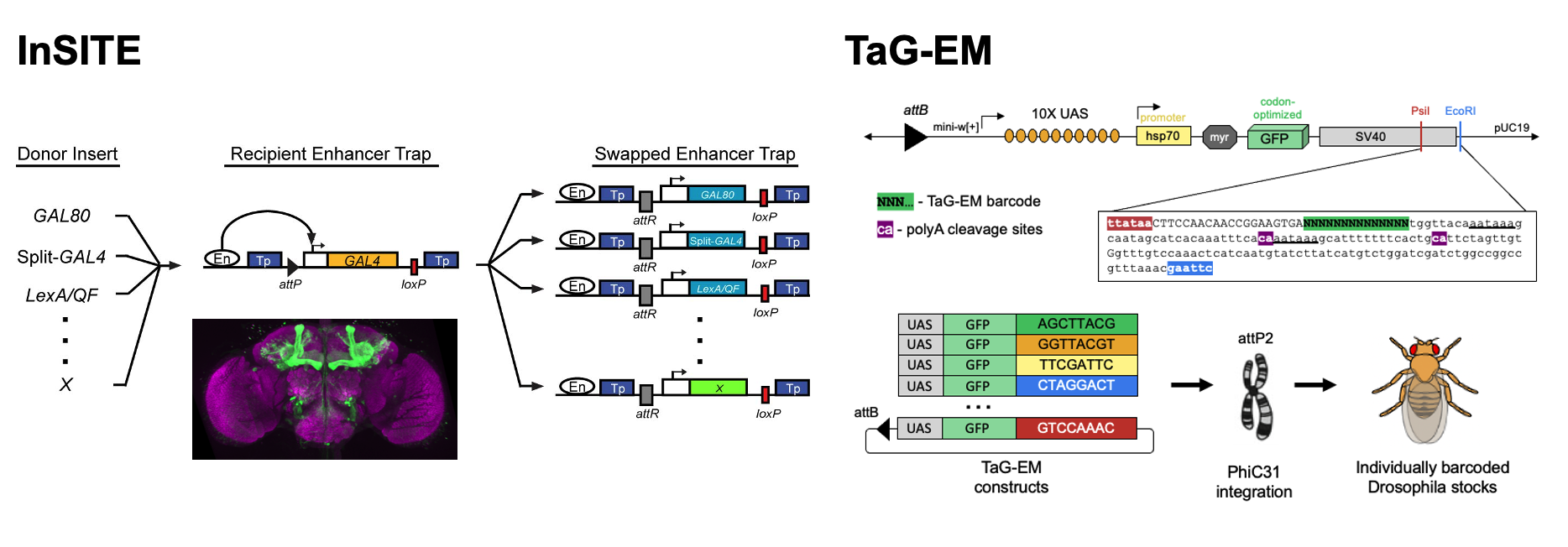
The InSITE system (left) uses site-specific recombinases to allow genetic conversion of a GAL4 enhancer trap line to another genetic effector. TaG-EM genetically barcoded fly lines enable multiplexed behavioral assays that can be read-out using DNA sequencing and TaG-EM barcodes can additionally be expressed tissue-specifically for in vivo labeling of cell populations upstream of single cell transcriptomic experiments.
Featured publications:
Blanco Mendana, J., Donovan, M., Gengelbach, L., Auch, B., Garbe, J., Gohl, D.M. 2023. Deterministic Genetic Barcoding for Multiplexed Behavioral and Single-Cell Transcriptomic Studies. eLife 12:RP88334. https://doi.org/10.7554/eLife.88334
Genomics Technology Development
The UMGC Innovation Lab aims to improve the accuracy and expand the scope, scale, and resolution of genomic measurements.
Microbiome
The microbiome plays a critical role in human health and disease, as well as the health of our planetary ecosystem. The UMGC Innovation Lab has been working to improve the accuracy and resolution of microbiome measurements. Our contributions include uncovering mechanistic insights into several forms of error and bias in amplicon-based microbiome studies. In these experiments, we also discovered an unexpected phenomenon, editing of the amplification primers during PCR, which can be exploited to expand the set of taxa that can be detected.
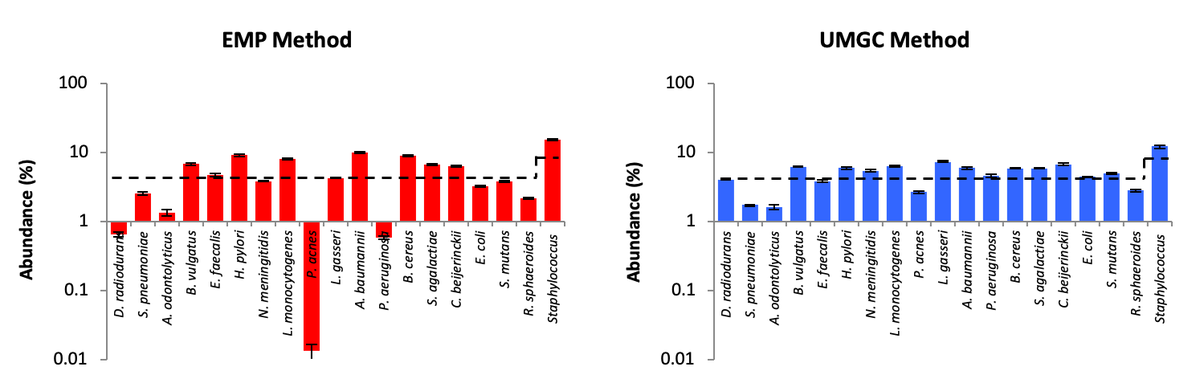
An optimized protocol for amplicon-based microbiome profiling. Comparison of the Earth Microbiome Project (EMP) protocol (left) and the UMGC-developed protocol (right). Plots show mean abundance +/- SEM of each organism in the HM-276D even mock community. Expected abundances are indicated with the dashed line.
Molecular Metrology
The UMGC Innovation Lab has employed synthetic standards for quantifying error and bias in a number of DNA sequencing workflows. We have developed a novel method (REcount) which allows for PCR-free quantification of engineered constructs using Illumina sequencing and have used REcount to quantify size biases across different sequencing platforms.
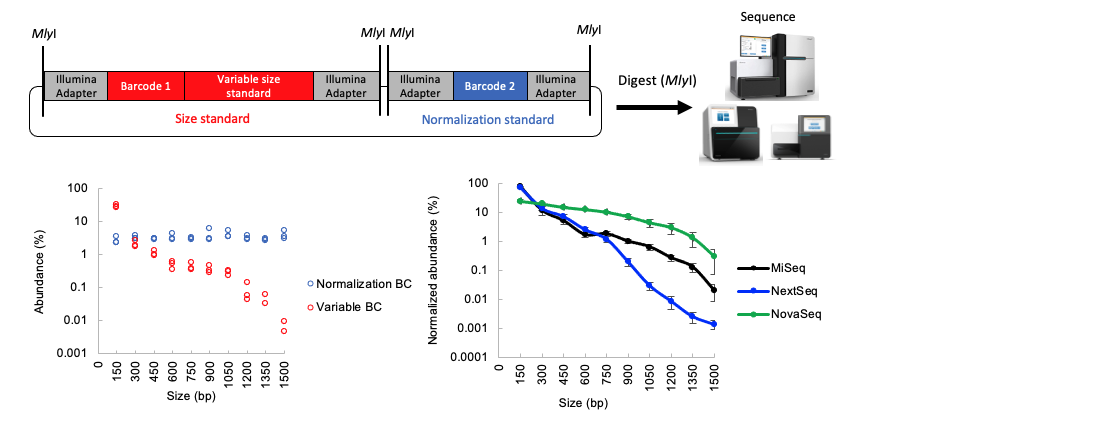
Illumina size standards allow measurement of sequencer-specific size biases. Top) Design of REcount-based Illumina size standard constructs. Each standard construct contains a normalization barcode, as well as a barcode associated with a variable size standard that can be liberated by MlyI digestion and directly sequenced. Left) Raw abundance data for all 30 size standards and normalization barcodes from a MiSeq run. Right) Size bias profiles of the MiSeq (n=6 flow cells), NextSeq (n=4 flow cells), and NovaSeq (n=1 flow cell, 1 lane) sequencers.
Invasive Species Genomics and Genetic Biocontrol
The UMGC Innovation Lab is using information from the zebra mussel genome to carry out population genomic analysis and to develop genetic biocontrol tools.
Zebra mussels
UMGC Innovation Lab scientist help lead a project sequencing the zebra mussel genome in collaboration with scientists at MAISRC and MSI. We have been using the information in the zebra mussel genome to develop RNA interference based methods for zebra mussel biocontrol. In addition, we are using genotyping-by-sequencing to characterize zebra population structure and to reconstruct the history of invasions in the Upper Mississippi River Basin.
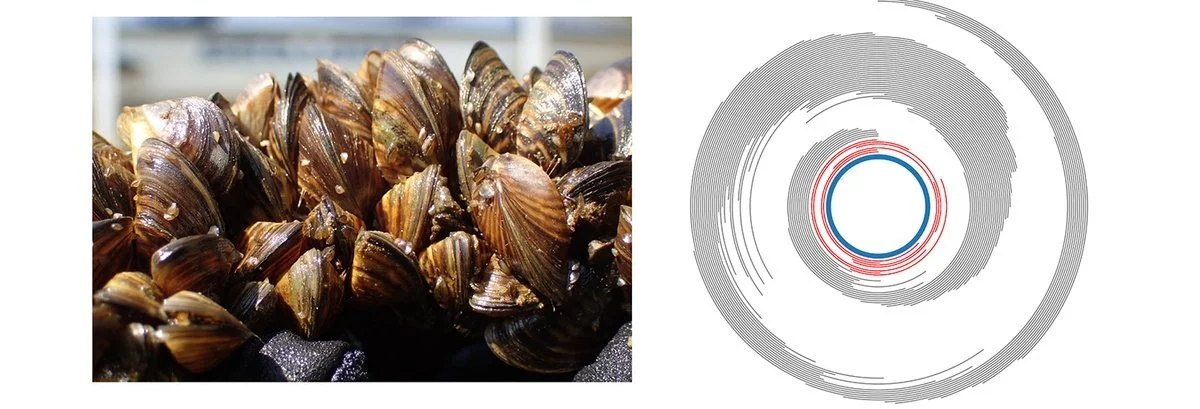
Zebra mussels (D. polymorpha). Photo by N. Blinick (Left). Plot of long (>25 kb) Oxford Nanopore (red) and PacBio (grey) reads supporting the proposed 67 kb circular D. polymorpha mitogenome structure (Right).
Featured publications:
Technology Commercialization
In addition to research and education, it is the mission of the University of Minnesota to apply our knowledge and discoveries to benefit the people of the state, the nation, and the world. One way that we do this is through technology commercialization. UMGC Innovation Lab scientists have filed multiple patent applications on new genomics technologies that have been developed at the University of Minnesota and have also worked to translate discoveries through company formation.
Granted patents
Analytical standards and methods of using same (US Patent Number 11286518, Japanese Patent Number 703643, Chinese Patent Number CN 201780041504.X). Inventors: K. Beckman, D. Gohl.
Size standards for next-generation sequencing (US Patent Number 11767554B2). Inventors: D.M. Gohl, K.B. Beckman.
Multi-perspective microscopic imaging guided microinjection of microscopic objects across large field of views (US Patent Number 12094161). Inventors: S.B. Kodandaramaiah, D.M. Gohl, A. Alegria, A. Joshi, B. Auch
Patent applications
Robotic barcode tagging of distinct cell populations in intact tissue (US Patent App. 63/248,823). Inventors: S.B. Kodandaramaiah, D. Gohl, L. Vulchanova Hart, J. O'Brien
Technology Commercialization Activities
Founded CoreBiome, Inc. in 2016, a microbiome services company, which was acquired by OraSure Technologies.
Founded Objective Biotechnology, Inc. in 2023.

